- Free shipping from 990 sek (within Sweden)
- Municipality and Company

.png?max-width=780&max-height=312&quality=85)
Test Handcranked Radios
In a state of emergency, there are different things to adhere to. The general recommendation when receiving an alert to the public is to go inside, close doors, windows and ventilation, but also to tune in to the emergency broadcasting network on your radio.
There are several ways that the authorities can reach you with vital information, but since television, apps and mobile phones might be affected by a power outage, an emergency radio is the most reliable means of getting information.
Dynamo radio, emergency radio or crank radio are the same sort of communication equipment where you can receive information and don’t have to rely on the power grid. The current selections of radios have a lot of other benefits though, they are not just a radio. Several of the models that are available in the market today has features such as flashlights, power banks, clocks and alarms built into them. Lately, the market has been flooded by several different brands and models and therefore we have identified the need for a thorough walkthrough of the ones that are available now.
How we tested all these radios
It is not easy to review an emergency radio in a realistic way, but we do believe that we have found ways to do some extensive pressure testing. Some of the ways we have tormented the devices are obvious, but we also figured out some scenarios of our own.
Endurance and discharging
In this scenario we let the radio play sound from a radio station in a normal volume. But we also put the flashlight on and let it brighten up our mood. The thought behind this is that we envisioned a situation where you might be in a really bad situation, possibly in a bomb shelter, and that you would probably benefit from having your surroundings lit.
All the radios were fully charged before the test and we let them play until they couldn’t produce any more sound.
The crank test
We endured this task to give a realistic picture of how it is like to crank the radio enough so that you can listen to it for quite some time. In the product specifications, there is often noted how long you can listen to the radio after cranking it for one minute. But in a real crisis situation, you realistically need to have the radio on for a long time to make sure you are not missing any important information. That’s why we settled for nothing less than ten minutes with the crank.
Receiving radio transmissions
When we planned this test, we thought hard about receiving the important radio transmissions. Most of the radios work really well on the surface, but how well do they perform when you need to get under ground? Would you have use for your radio if you needed to evacuate to a shelter below ground?
We tested all the radios in three different levels:
- In a basement, about three meters under the ground
- In a parking garage under an apartment complex, about six meters under the ground
- In a parking garage deep down, with hundreds of tons of mountain and concrete above it, 15-20 meters under ground
HR-032
If you are out to get a visible and easily found radio with a nice form factor, this might just be the one. It has all the essential functions and delivers well for a really affordable price.

Discharge from full charge
With the flashlight turned on and the radio tuned to the radio station that delivers emergency information, it powers through seventeen hours of light and sound before it surrenders.
Ergonomics - crank
The shape of the radio makes it comfortable to hold while cranking. The knob at the end of the crank makes it comfortable to grab onto. When working with the crank I experience the resistance in the dynamo as somewhat low. I don’t experience any fatigue in my thumb or hand even after ten minutes of hard work.
Charging - crank
After ten minutes of hard work, the radio shows full charge. But it can only muster 48 minutes of light and music before it dies.
Charging – solar panels
After being exposed to the Swedish spring sun for three hours, it is charged enough to deliver twenty minutes of radio and light.
Receiving radio transmissions
- 3 meters: we experience good reception with good audio quality
- 6 meters: it’s a bit harder to get good reception but after a couple of tries, we succeed well
- 15-20 meters: deep in the parking garage, we get no reception at all. But when we connect the antenna to a sprinkler pipe, we do get reception even though it is not very good
Using the radio
The device has quite small buttons, but they are labelled with white text which means that you can easily see which button is for what. You can use either ordinary AAA-batteries or the chargeable battery, which you can access from the bottom of the radio. To change the battery, you will need a smaller, cross-headed screwdriver.
Facts
- Size: 155 x 75 x 46 mm
- Battery: 2000 mAh Li-ion (replaceable)
- Weight: 270g
- Features: Waterproof (IPX 3), LED-lamp, alarm, AM/FM-radio
- Contacts: USB micro for charging the radio, USB A for powerbank, headphone jack
- Charging: Dynamo (crank), solar panels or USB micro
Overall
A nice emergency radio that feels quite robust. It is waterproof and has a good battery capacity (replaceable battery) which is really great. This is a slick, affordable radio that covers most of your prepping needs.
MD-090
In the mid-range tier when it comes to price, this device will boost your preparedness with its smart features. It feels nice to have in your hand and has a form factor we like. The radio is also available in red.

Discharge from full charge
The sound that is coming from the wardrobe is a result of more than ten emergency radios under hard pressure. MD-090 fights to the bitter end while shedding light and receiving radio waves from the station that is supposed to deliver emergency information. It goes on for about 12 hours before it goes silent and the lights go out.
Ergonomics - crank
This radio feels really good to hold on to while charging. The edges are made out of soft plastic and since its quite small, it fits well in the palm of my hand. After ten minutes of cranking this radio, I don’t suffer from any pain in my hands, which is really good.
Charging - crank
After the brutal test in the wardrobe, I pick the radio up and use pure muscle power to charge it. After ten minutes of physical labor, I get one hour of radio and light.
Charging – solar panels
The unit gets to bathe in the lovely, Swedish weather that is delivered through a mix of clouds and some pure sun rays. After three hours, we can listen to radio and use the LED lamp for about 50 minutes.
Receiving radio transmissions
- 3 meters: In the basement we get quite good reception. There is some interference but not very much
- 6 meter: no reception
- 15-20 meters: no reception until we try touching the sprinkler pipes with the antenna. In this state we can distinguish the voices in the transmission.
Using the radio
This unit provides you with the possibility to use ordinary AAA-batteries instead of the built-in battery. We also really appreciate the reading light, which can be used to light up a bigger area as well as provide you with light for reading.
Facts
- Size: 157 x 74 x 53 mm
- Battery: 2000 mAh Li-ion (replaceable)
- Weight: 310g
- Features: Waterproof (IPX 3), LED-lamp, alarm, AM/FM-radio, reading light, possible to use ordinary batteries
- Contacts: USB micro for charging the radio, USB A for charging external devices
- Charging: Dynamo (crank), solar panels, USB micro
Overall
We find it a bit difficult to adjust the tuning because of the small frequency scale and since the knobs are a bit small. But besides that, this is a really nice emergency radio. We really like the possibility to use ordinary batteries in combination to the built-in battery. The reading light is also a nice feature since you need to be able to read even during a crisis!
HY-018WB
Quite similar to the MD-090 in appearance. Overall a good choice for the prepper that needs a good, affordable radio.

Discharge from full charge
After topping up the battery in the radio, we put it to the test as with all of our victims; to stay in the wardrobe playing music and lighting up the space for as long as possible. This little device surprises us with a fighting spirit we did not expect. It keeps up the fight for as long as 22 hours before giving up.
Ergonomics - crank
The radio feels OK in the palm of my hand, but when I start the gruesome task with cranking it for ten minutes, I can feel a much greater resistance in the dynamo immediately. It is quite hard to get to the right speed and the knob is quite small which makes it difficult to handle in an ergonomic way.
Charging - crank
The pain and hard work seem to be worth it though. After ten minutes of intense cranking, I am rewarded by music and light for one hour and ten minutes.
Charging - solar panels
After three hours of partly cloudy weather, we get the same effect as using the crank for ten minutes; one hour and ten minutes of sound and light.
Receiving radio transmissions
- 3 meters: as suspected we get quite good reception in the basement.
- 6 meters: unfortunately no reception at all
- 15-20 meters: no reception here either, not even when I try touching the aprinkler pipes with the antenna
Using the radio
This is a nice radio. Thanks to the reading light and the possibility to use ordinary AAA-batteries, it qualifies as a versatile device which will add to your preparedness.
Facts
- Size: 155 x 75 x 46 mm
- Battery: 2000 mAh Li-ion
- Weight: 270 g
- Features: Waterproof (IPX 3), LED-lamp, alarm, AM/FM-radio, reading light, possible to use ordinary batteries
- Contacts: USB micro for charging the radio, USB A for charging external devices, headphone jack
- Charging: Dynamo (crank), solar panels or USB micro
Overall
Although the resistance of the dynamo is high, I like this radio. The possibilities when it comes to charging are good. Unfortunately, the knobs for adjusting the frequency are a bit too small.
MD-088+
A cheaper crank radio to use in the cabin or as an extra backup for the prepper with a lower budget.

Discharge from full charge
As with all the radios in this test, we make sure it is fully charged before we throw it to the wolves. It holds up for about 12 hours before it gives up although we can still squeeze a couple of hours of light even then.
Ergonomics - crank
The dynamo gives great resistance and even though the body of the radio is comfortable to hold, my hands ache after ten minutes.
Charging - crank
After ten minutes of pain and hard work, we’re able to get about 40 minutes of radio and light from this radio.
Charging - solar panels
After three hours of sunlight, we get 40 minutes of radio and light before this unit goes back to its sleep.
Receiving radio transmissions
- 3 meters: nice sound with good reception
- 6 meters: a bit of white noise but otherwise no reception
- 15-20 meters: we pick up odd signals but nothing that sounds like a transmission. We experience the same thing when we try using the sprinkler pipes
Using the radio
This is an OK radio overall. It is a bit tricky to adjust the frequency and it does not work wonders under the ground. But if you use it as an emergency radio at your summer retreat or house, it’s a bargain.
Facts
- Size: 146 x 61 x 77 mm
- Battery: 2000 mAh Li-ion (replaceable)
- Weight: 300 g
- Features: Waterproof (IPX 3), LED-lamp, alarm, AM/FM-radio
- Contacts: USB micro for charging the radio, USB A for charging external devices
- Charging: Dynamo (crank), solar panels or USB micro
Overall
Although it has some flaws like the sensitive and small knobs for setting the frequency and the limited battery capacity, it’s an OK radio. If you already have another emergency radio, this will do fine as a backup.
MD-088
Probably one of the most common emergency radios in the market since it comes with an affordable price and most of the things you would expect from a unit as this.

Discharge from full charge
As expected, this unit keeps it up for quite some time. You can count on at least 11 hours of radio and light.
Ergonomics - crank
The radio feels very good in the palm of my hand and the knob on the crank is shaped perfectly for our needs. Cranking it for ten minutes feels like a breeze!
Charging - crank
Ten minutes of joyful cranking gives us somewhere around 30 minutes of radio and light in the wardrobe.
Charging - solar panels
After three hours of sunbathing however, the device shows no signs of waking up at all. According to the manufacturer, it should be fully charged after 12 hours of sunlight.
Receiving radio transmissions
- 3 meters: We experience some interference in the basement but other than that, we have no issues hearing what is said on the radio
- 6 meters: In the garage, we can not get any reception at all
- 15-20 meters: no reception whatsoever
Using the radio
The radio is equipped with quite small knobs, which makes it hard to find the correct frequency. It is possible to change the battery by unscrewing a small door in the bottom of the device. It does look challenging though, since the compartment for the battery seems very cramped.
Facts
- Size: 128 x 60 x 40 mm
- Battery: 1000 mAh (replaceable)
- Weight: 226g
- Features: 3 LED-lamps, AM/FM/WB-radio
- Contacts: USB Micro for charging the radio, USB A for charging external devices
- Charging: Dynamo (crank), solar panels or USB micro
Overall
A cost-effective radio suitable for the prepper with a low budget. Don’t expect any miracles or reception underground with this device.
MD-097
Prepping for a crisis but at the same time want to enjoy some nice music on the beach? This unit might be the one for you, especially if you are on a budget!

Discharge from full charge
Before we let this radio play The Beach Boys until it falls over, we make sure it’s fully charged. After 19 hours of music and bright light, the MD-097 wipes out and falls asleep.
Ergonomics - crank
Even though its shape is quite odd, it feels comfortable to hold when I use the hand crank to charge the battery. The dynamo provides a lower resistance than the radios I tried before and even though I sometimes experience it as slightly cumbersome to hold, I do not feel any pain even after ten minutes.
Charging - crank
The hard work does come with benefits. Ten minutes of cranking gives me one hour and twenty minutes of sound and light.
Charging - solar panels
The big solar panel absorbs enough energy to charge the battery so that we can enjoy one and a half hours of music and light – impressive!
Receiving radio transmissions
- 3 meters: crisp sound and excellent
- 6 meters: some static noise but we have no problem hearing the transmission
- 15-20 meters: although there is alot of white noise in the reception, we can still hear what is being said in the radio transmission, using only the antenna
Using the radio
A durable and well put together emergency radio that basically has everything. The big solar panel gives you a better charge, replaceable battery and the possibility to use ordinary batteries makes this unit quite versatile. It is a bit hard to make out the tet of the buttons in the dark, but overall a great buy!
Facts
- Size: 202 x 90 x 80 mm
- Battery: 4000 mAh Li-ion (replaceable)
- Weight: 490 g
- Features: Waterproof (IPX 3), LED-lamp, alarm, AM/FM-radio
- Contacts: USB micro for charging the radio, USB A for charging external devices, AUX
- Charging: Dynamo (crank), solar panels or USB micro
Overall
One of the best radios for the prepper with a budget. A beast in the bunker as well as on the beach and an absolute must for your preparedness!
Eton FRX3+
Ever since Eton’s flagship FRX5-BT was retired, a lot of preppers have been searching for a worthy replacement. Even though FRX3+ lacks the huge solar panel that the predecessor had, I dare suggest that this red beast is the right way to go.

Discharge from full charge
After topping up the battery, the radio keeps on blaring sound and lighting the room for 28 hours. Twenty-eight hours! As far as my scale goes, this is way above my expectations, especially when considering that the radio “only” is powered by a battery with 2600 mAh.
Ergonomics - crank
Someone in Eton’s research department has done their homework well. The knob on the crank has two different sizes; one small and one that is a bit larger. This means that the radio is not only suited for different age groups but also gives the opportunity for you to alternate between the two sizes to combat “cranking fatigue”.
The resistance from the dynamo is a bit high, but works really well to get the body heat raised in just ten minutes.
Charging - crank
After enduring ten minutes of cranking, we can enjoy music, information and light for almost one and a half hour. Totally worth it, especially since the sound quality is so good!
Charging - solar panels
While suffering from the loss of the enormous solar panel that the FRX5-unit had, this device manages to absorb enough light and energy during the three hours of sunlight to produce well sounding music and bright light for one hour and forty-five minutes.
Receiving radio transmissions
- 3 meters: no doubt about it. FRX3+ loves producing nice sound, whether it is in the basement or above ground
- 6 meters: we get some static in the reception but can hear everything loud and clear
- 15-20 meters: without any external aid whatsoever, we can easily receive the tra It doesn’t sound great, but we have no problem receiving the information
Using the radio
FRX3+ boasts with so many features and solutions that it immediately becomes a favorite. The battery is replaceable and delivers power like no other radio in this test. The sound is really good and it’s easy to navigate the controls.
The only thing that bugs me is that the manufacturer chose USB mini instead of USB micro (of which we all have an abundance of cables lying around). I might be picky when it comes to this, but as a prepper you need to assure that you have several extra cables than the one included in the package. USB mini is not the standard anymore unfortunately.
Facts
- Size: 147 x 175 x 66 mm
- Battery: 2600 mAh (replaceable)
- Weight: 420 g
- Features: LED-lamp with red light, alarm, AM/FM-radio, light-up display
- Contacts: USB mini for charging the radio, USB A for charging external devices, AUX-input, headphone socket
- Charging: Dynamo (crank), solar panels or USB mini
Overall
An awesome radio that is well worth your money. The only thing missing for a perfect score would be that the device does not support ordinary batteries. Besides that, this is a given for your next investment and a very good way of increasing your preparedness!
Eton Scorpion II
An all-time favorite thanks to its small form factor and its ruggedness.

Discharge from full charge
Even though this unit has one of the smallest batteries in the test, we manage to torment it for eleven hours with radio and lights. After giving up on the sound, the radio keeps delivering light for an additional seven hours.
Ergonomics - crank
The crank feels good to hold in my hand, even after ten minutes of hard work. The radio however, is a bit too small to make me feel comfortable holding it in a proper way.
Charging - crank
After ten minutes of cranking, the Scorpion delivers a bit more than half an hour of sound and light.
Charging - solar panels
After spoiling the unit with a sunny siesta for three hours, it manages to deliver an additional two hours of radio and light.
Receiving radio transmissions
- 3 meters: it works very well in the basement. It delivers good sound with a bit of depth to it.
- 6 meters: we do get good reception here, even though it’s mixed with quite a lot of static sound
- 15-20 meters: no reception until I put the antenna to the sprinkler pipes that treverse this underground garage
Using the radio
Scorpion II is a comfortable and small emergency radio which has all the components you need. It has a battery compartment which is accessible on the bottom. The battery looks easy to replace.
The buttons for handling volume and frequency are all made of black rubber without any bright markings, which makes it hard to find the right ones in the dark or if you have poor eyesight.
Facts
- Size: 164mm x 69mm x 48 mm
- Battery: 800 mAh Li-ion (replaceable)
- Weight: 301 gram
- Features: Waterproof (IPX 4), LED-lamp, AM/FM-radio, bottle opener
- Contacts: USB micro for charging the radio, USB A for charging external devices, earphone jack
- Charging: Dynamo (crank), solar panels or USB micro
Overall
A winner in the category smaller emergency radios. Except for the buttons which are hard to read, this is a masterpiece that every serious prepper should have in their car, Go Bag or home.
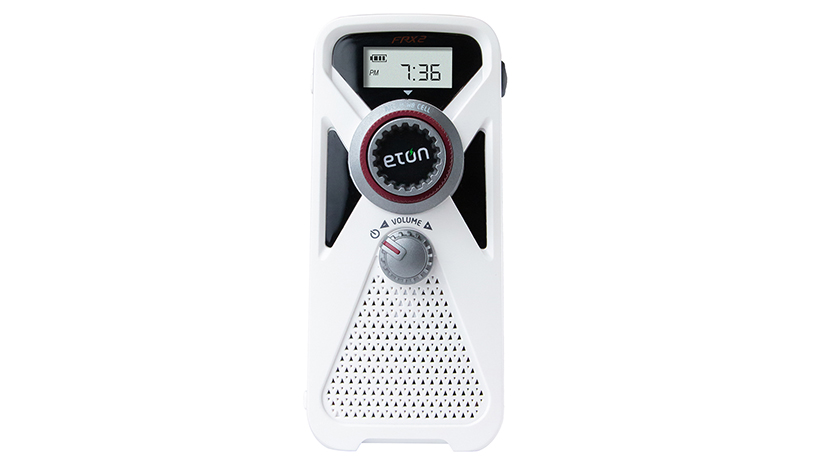
Eton FRX2
This unit reminds us of the smaller FR1 model, both in regard to the shape and feel, but has a smaller battery and a solar panel to charge the device.
Discharge from full charge
The difference in endurance when compared to FR1 is quite big. It can provide 12 hours of sound even though the lights still work.
Ergonomics - crank
The same feeling of resistance in the dynamo and the same type of fatigue after cranking for ten minutes.
Charging - crank
After enduring the ten minutes of physical work, charging the battery, we get almost exactly one hour of radio and light. After that we can get the lights to work but not the radio.
Charging - solar panels
FRX2 gets the same, royal treatment as all the radios; three hours in the Swedish springtime sun. After this time, the battery has gotten enough of a charge to deliver 50 minutes of radio before it gives up.
Receiving radio transmissions
- 3 meters: the sound is OK in the basement, we experience some interference depending in which direction we point the antenna
- 6 meters: we can distinguish a real difference in the garage, where the sound consists more of white noise than anything else. After finding the sweet spot for the antenna, we do get reception though
- 15 -20 meters: no matter what we try, we receive only white noise
Using the radio
This is basically a different version of FR1 and for the most part, the experience is identical. Adjusting frequency is however done by turning a knob which changes the digital tuner. This makes it easy to set the correct frequency.
Facts
- Size: 137 x 64 x 61 mm
- Battery: 1000 mAh (replaceable)
- Weight: 250 g
- Features: LED-lamp, alarm, AM/FM-radio
- Contacts: USB mini for charging the radio, USB A for charging external devices, headphone jack
- Charging: Dynamo (crank), solar panels or USB mini
Overall
A really nice pocket radio which has a natural place in the car or in your apartment. The possibility to charge the battery with solar energy is good to have, but the most important difference between this and the FR1 is the replaceable battery.
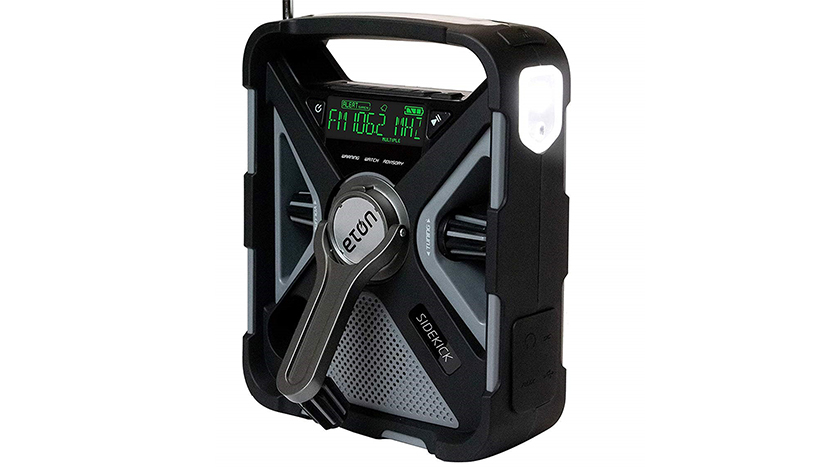
Eton Sidekick
Another choice if you are looking for a worthy replacement of FRX5. This unit, however, is more aimed for the prepper who wants an awesome work light.
Discharge from full charge
Even though the radio has the same battery as FRX3+, it only manages to play radio and light up the room for 18 hours. This in comparison to FRX3+ which delivered 28 hours.
Ergonomics - crank
The knob on the crank is quite sharp, presumably to offer a better grip. But this has its price when it comes to comfort, which we start experiencing after about 5 minutes. The dynamo, however, seems well adjusted with a higher resistance when we crank slowly, but feels perfect at the correct speed (two revolutions per second).
Charging - crank
Ten minutes of cranking gives us about 23 minutes of radio and lights.
Charging - solar panels
We are rewarded with 50 minutes of sound and light after letting the unit enjoy 3 hours in the sun.
Receiving radio transmissions
- 3 metes: as expected; really good reception and a clean, nice sound
- 6 meters: a bit of static in the reception, otherwise really good
- 15 -20 meters: even though the static has increased, we can still easily make out the message delivered in the transmission. No need to use the sprinkler pipes
Using the radio
This might be the unit that has it all. A big battery, backlit knobs and display, good reception, Bluetooth and also the possibility to connect your old cassette player via AUX for some prepper nostalgia.
Facts
- Size: 181 x 148 x 59 mm
- Battery: 2600 mAh Li-ion (replaceable)
- Weight: 612 g
- Features: Waterproof (IPX 4), LED-lamp, work light, alarm, AM/FM-radio, Bluetooth
- Contacts: USB micro for charging the radio, USB A for charging external devices, AUX input, headphone jack
- Charging: Dynamo (crank), solar panels or USB micro
Overall
A beast of a radio that works well both on the beach, in the garage and of course as an emergency radio. The work light really delivers a shining and bright experience. A real winner which needs to be a part of your prepper equipment.
Powerplus Falcon
A LED-light with a built-in radio.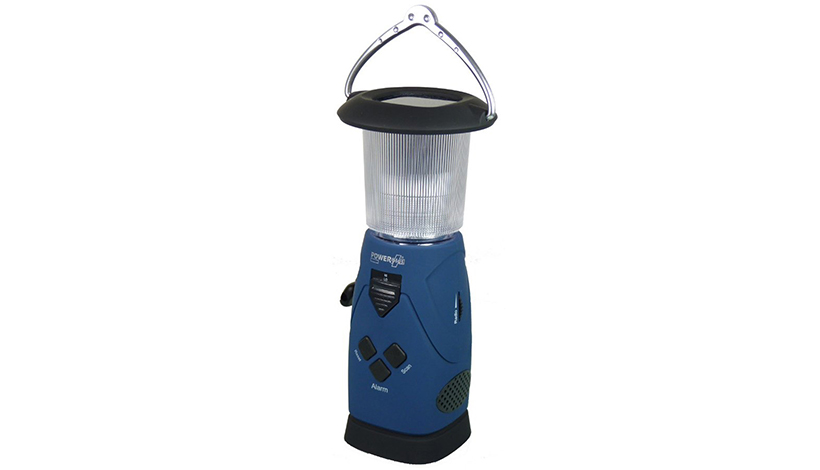
Discharge from full charge
The radio and the bright light struggle on for about 12 hours before going out.
Ergonomics - crank
The crank has a quite small knob, which makes it a bit hard to hold in a good way. Despite this, it feels OK and combined with the good grip that the housing provides, it feels good.
Charging - crank
After cranking for ten minutes, the unit struggles to provide 16 minutes of radio and light.
Charging - solar panels
Unfortunately, the solar panel is way too small to make any difference at all in the cloudy country of Sweden. Even after sunbathing for three hours, it shows no signs of life.
Receiving radio transmissions
- 3 meters: static sound
- 6 meters: no reception
- 15 -20 meters: no matter what we try, no reception
Using the radio
Since there is no extendable antenna, this emergency radio does not cope with any challenges at all when it is under the ground. Setting the correct frequency is also a challenge since the unit only has one button for scanning, nothing else.
Facts
- Size: 190 x 80 x 80 mm
- Batteriy 1200 mAh (3 X 400mAh AAA chargeable and replaceable)
- Weight: 280 g
- Features: LED-lamp (2 modes), alarm, AM/FM-radio
- Contacts: input for charging cable, headphone jack
- Charging: Dynamo (crank), solar panels or with cabel (Powerplus own solution)
Overall
This is an OK radio/lamp. However, the charging solution is a bit of a mess since you need to use the special cable that is included in the package. On a positive note, you can use ordinary or rechargeable AAA-batteries.
Powerplus Lynx
A small and handy radio with nice features.

Discharge from full charge
After charging the radio, it manages 10 hours of radio and light before it goes dark.
Ergonomics - crank
The dynamo provides some real resistance, which should mean that we add more power to the battery. The crank feels OK but since the radio is quite small and has its unique features, it’s hard to find a comfortable way of holding it.
Charging - crank
After ten minutes of cranking, we’re happy to see that the radio works for more than an hour before giving up again.
Charging - solar panels
As all the radios, the Lynx also gets its share of sunbathing in the Swedish sun. This charges the battery enough to be able to provide us with 45 minutes of sound and light.
Receiving radio transmissions
- 3 meters: quite good sound and reception
- 6 meters: very hard to get reception with enough quality to hear what is said
- 15 -20 meters: no signal, however hard we try
Using the radio
This unit also has Powerplus special cable to charge it, which is never a good thing. But besides that, this radio is actually quite good.
Facts
- Size: 74 x 153 x 55 mm
- Battery: 300 mAh (replaceable)
- Weight: 300 g
- Features: LED-lamp, AM/FM-radio
- Contacts: input for charging cable, headphone jack
- Charging: Dynamo (crank), solar panels or with cabel (Powerplus own solution)
Overall
A nice radio for the cabin. The only downsides to the unit are the special cable (not USB) needed for charging and the weaker battery.
Sangean MMR88
A real hero when it comes to emergency radios. No matter what.

Discharge from full charge
After topping up the charge, this unit delivers a bit more than 16 hours of sound and light.
Ergonomics - crank
The crank has a rather small knob, which makes a bit difficult to get a hold of which adds to the fatigue of the fingers. On the other hand, it’s really easy to get a form grip of the radio.
Charging - crank
After cranking for ten minutes, we get music and light for more than an hour; 67 minutes to be exact.
Charging - solar panels
Letting the sunshine on the solar panels for three hours, makes the MMR80 ready to deliver more than an hour of music and lights.
Receiving radio transmissions
- 3 meters: very good reception without any interference at all
- 6 meters: in the garage, we also get very good reception
- 15 -20 meter: this is where the Taiwanese wonder really shows off. It is the only unit that immediately delivers good reception without any problem at all. It’s probably thanks to the really long antenna
Using the radio
The unit has big buttons on the side with clear symbols and text, a big display and it delivers good sound. The quite big solar panel and the easily accessible battery compartment are other highlights of this radio.
Facts
- Size: 152 x 70 x 84 mm
- Battery: 850 mAh Li-ion (replaceable)
- Weight: 392 g
- Features: Automatic power off after 90 minutes, LED-lamp, alarm, AM/FM-radio
- Contacts: USB micro for charging the radio, USB A for charging external devices, headphone jack
- Charging: Dynamo (crank), solar panels or USB micro
Overall
Sangean MMR80 has a really good form factor and delivers outstanding reception in any situation. The radio sets the standard for emergency radios and is well worth your money. The only thing I’m looking forward to in the future is an updated version with an even bigger battery.